Grass Seed Calculator: New Lawns and Overseeding
Enter the lawn size and pick the grass. We use a typical seeding rate for that grass, halve it for overseeding, and round up to the bags sold where you shop.
Your estimate
Buy 7 lb
of tall fescue seed · 1 bag (7 lb)
- Lawn area
- 1,000 sq ft
- Seeding rate
- 7 lb per 1,000 sq ftnew lawn
- Bags
- 1 bag (7 lb)
Add a price per bag to see the cost.
How we got this: 1,000 sq ft × 7 lb per 1,000 sq ft = 7 lb, in the bag sizes sold where you shop.
Spread half the seed in one direction and half at right angles for even cover, then rake it in lightly and keep it moist.
How the calculation works
- Rate. Each grass has its own rate, because seed size differs: about 7 lb per 1,000 sq ft (34 g/m²) for tall fescue but only 2.5 lb (12 g/m²) for tiny Kentucky bluegrass seed.
- Overseeding thickens an existing lawn, so it uses about half the new-lawn rate.
- Bags. Seed comes in a few bag sizes; we combine them to waste as little as possible.
Imperial example: a new 1,000 sq ft lawn of tall fescue needs 7 lb of seed: one 7 lb bag. Overseeding the same lawn needs 3.5 lb.
Metric example: a new 100 m² lawn with a general mix at 35 g/m² needs 3.5 kg: a 2.5 kg and a 1 kg box.
Guides to save and share
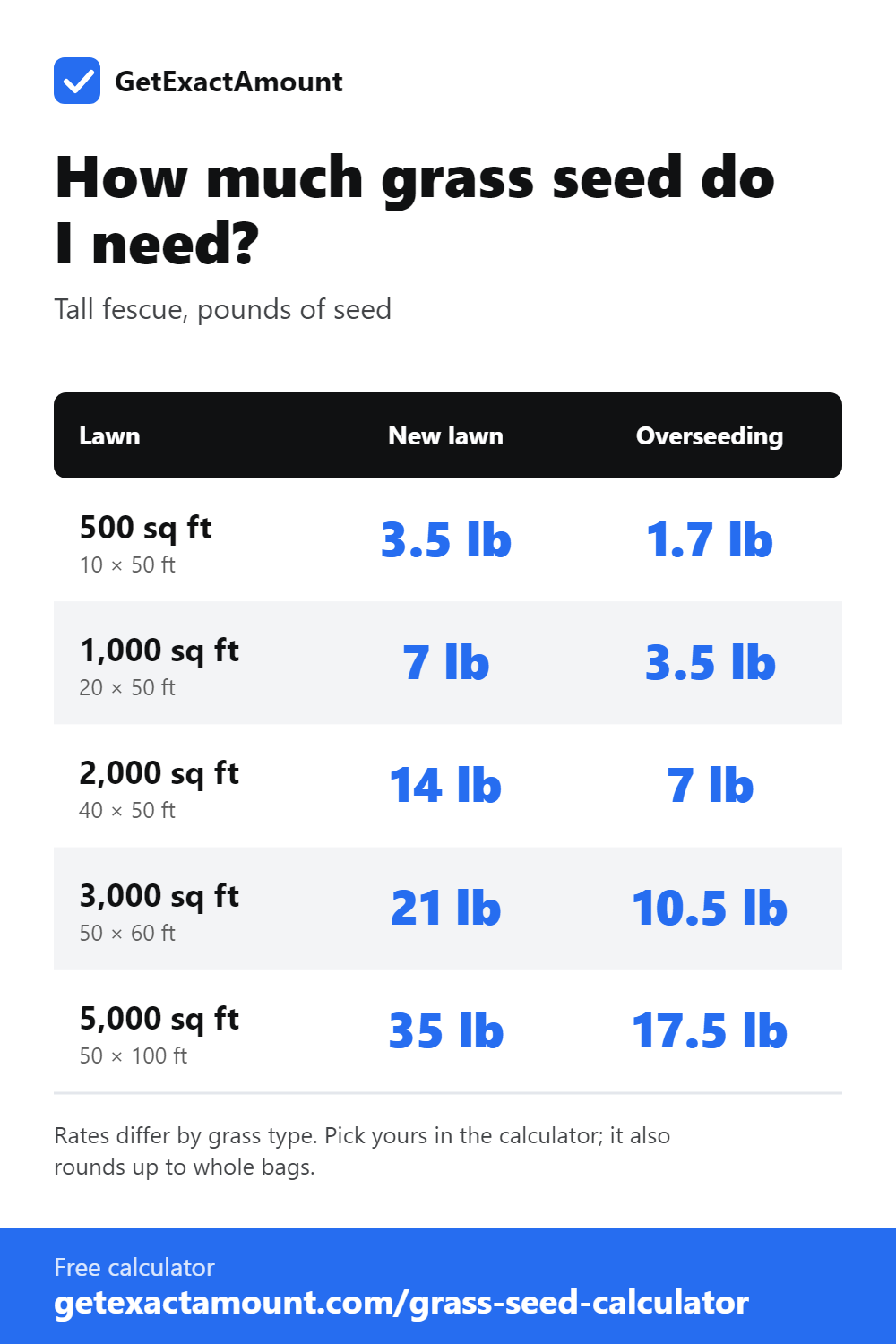
Chart as a table: How much grass seed do I need?
| Lawn | New lawn | Overseeding |
|---|---|---|
| 500 sq ft (10 × 50 ft) | 3.5 lb | 1.7 lb |
| 1,000 sq ft (20 × 50 ft) | 7 lb | 3.5 lb |
| 2,000 sq ft (40 × 50 ft) | 14 lb | 7 lb |
| 3,000 sq ft (50 × 60 ft) | 21 lb | 10.5 lb |
| 5,000 sq ft (50 × 100 ft) | 35 lb | 17.5 lb |
How much grass seed per square foot?
| Grass | New lawn | Climate |
|---|---|---|
| Tall fescue | 6–8 lb / 1,000 sq ft (30–40 g/m²) | Cool and transition zones; tough and drought tolerant |
| Kentucky bluegrass | 2–3 lb / 1,000 sq ft (10–15 g/m²) | Cool climates; spreads to fill gaps |
| Perennial ryegrass | 5–10 lb / 1,000 sq ft (25–50 g/m²) | Cool climates; fast to establish |
| Fine fescue | 4–5 lb / 1,000 sq ft (20–25 g/m²) | Shade and low maintenance |
| Bermuda (hulled) | 1–2 lb / 1,000 sq ft (5–10 g/m²) | Warm climates only |
Common mistakes
- Spreading seed on hard soil. Loosen and level the top inch, or the seed washes away.
- Burying seed too deep. Rake it in lightly: most grass seed needs light to sprout.
- Letting new seed dry out. Keep the top layer moist, with light watering once or twice a day, until it sprouts.
- Sowing in summer heat or late fall. Early fall is best for cool-season grasses; late spring for warm-season.
What else you'll need
- Topsoil for bare or poor ground: Topsoil Calculator
- A broadcast or drop spreader.
- Starter fertilizer for new lawns.
- A rake and a lawn roller, plus straw or seed mulch on slopes.
Frequently asked questions
How much grass seed do I need for 1,000 sq ft?
About 7 lb of tall fescue or 2.5 lb of Kentucky bluegrass for a new lawn, and half that to overseed.
How much grass seed do I need per square meter?
About 30–40 g for most lawn mixes when sowing a new lawn, and 15–20 g to overseed.
Can I put down too much seed?
Yes. Overcrowded seedlings compete for light and water and are more prone to disease. Stick close to the rate on the bag.
When is the best time to sow grass seed?
Early fall for cool-season grasses such as fescue, ryegrass and bluegrass; late spring to early summer for warm-season grasses such as Bermuda.
Related calculators
This is an estimate. Actual use depends on the material, the surface, the installation method, waste and site conditions. Check quantities with your supplier before you buy.