Gravel Calculator: How Much Gravel Do I Need?
Enter the area and depth and pick the gravel. We give the volume to order, its weight, the number of bags, and the cost by the ton, the yard or the bag.
Your estimate
Order 2 cu yd
of crushed stone ≈ 2.7 tons, or 105 bags (50 lb (0.5 cu ft))
- Area
- 200 sq ft
- Volume
- 1.94 cu yd (52.5 cu ft)5% waste
- Weight
- 2.62 tons
- In bags
- 105 bags (50 lb (0.5 cu ft))
Add a price per ton, cubic yard or bag to see the cost.
How we got this: 200 sq ft × 3 in × 1.05 = 1.94 cu yd (52.5 cu ft), × 1,600 kg/m³ = 2.62 tons. Delivery orders round up to the next 1/4 cu yd.
For a path or patio base, lay landscape fabric first and compact in 2 in (50 mm) layers; for loose decorative gravel, use edging to keep it in place.
How the calculation works
- Volume. Area × depth, plus 25% if the gravel will be compacted as a base, plus 5% for spreading.
- Weight. Volume × density: about 2,700 lb per cu yd (1.6 t/m³) for crushed stone and river rock, a little less for pea gravel.
- Order. Delivery is sold in steps of 1/4 cu yd (0.25 m³); bags are about 0.5 cu ft (50 lb) in the US.
Imperial example: a 10 × 20 ft path, 3 in deep, in crushed stone is 1.94 cu yd with 5%: about 2.6 tons, or 105 bags. Order 2 cu yd.
Metric example: a 5 × 4 m area, 50 mm deep, is 1.05 m³: about 1.7 tonnes, two bulk bags or 84 bags of 20 kg.
Guides to save and share
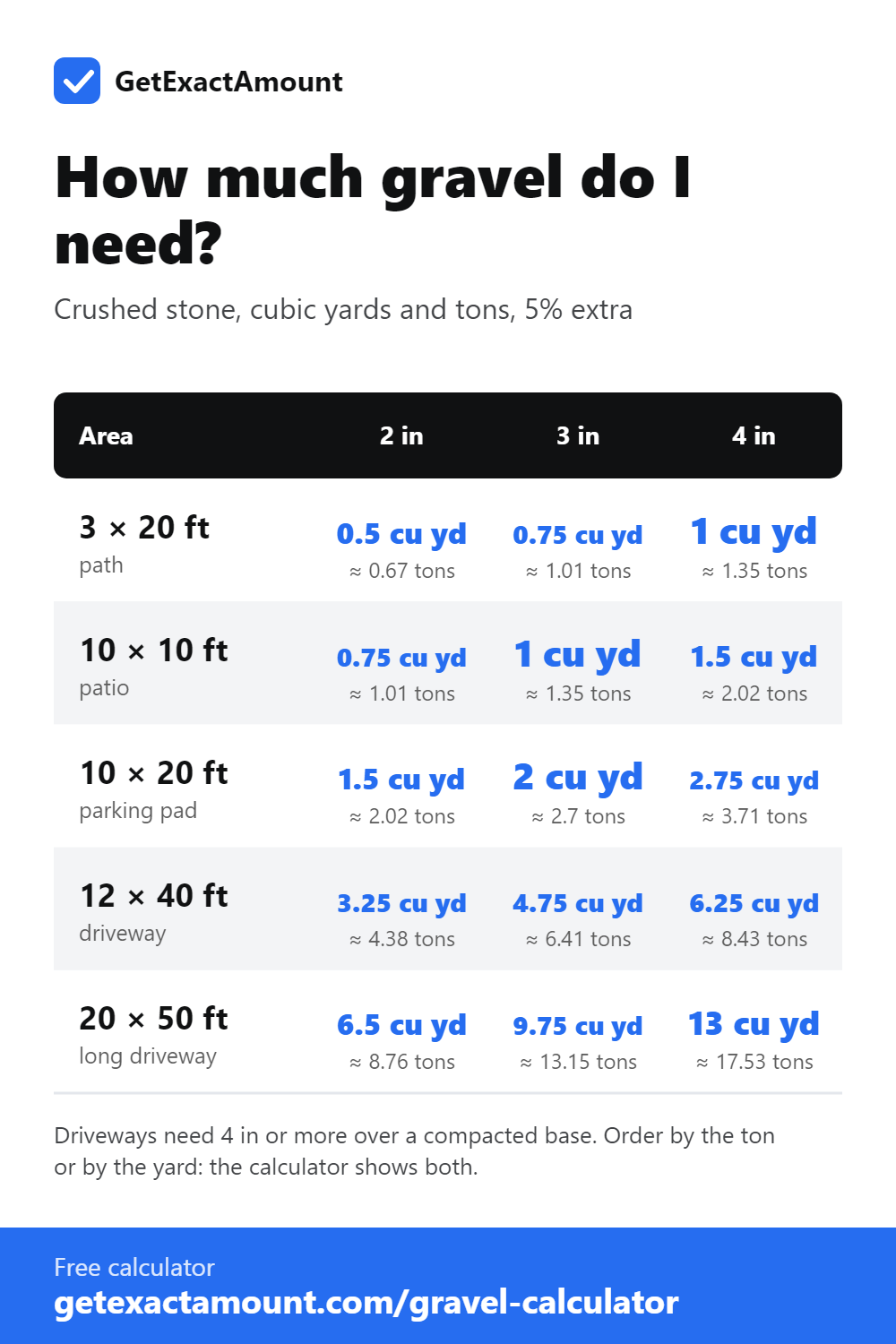
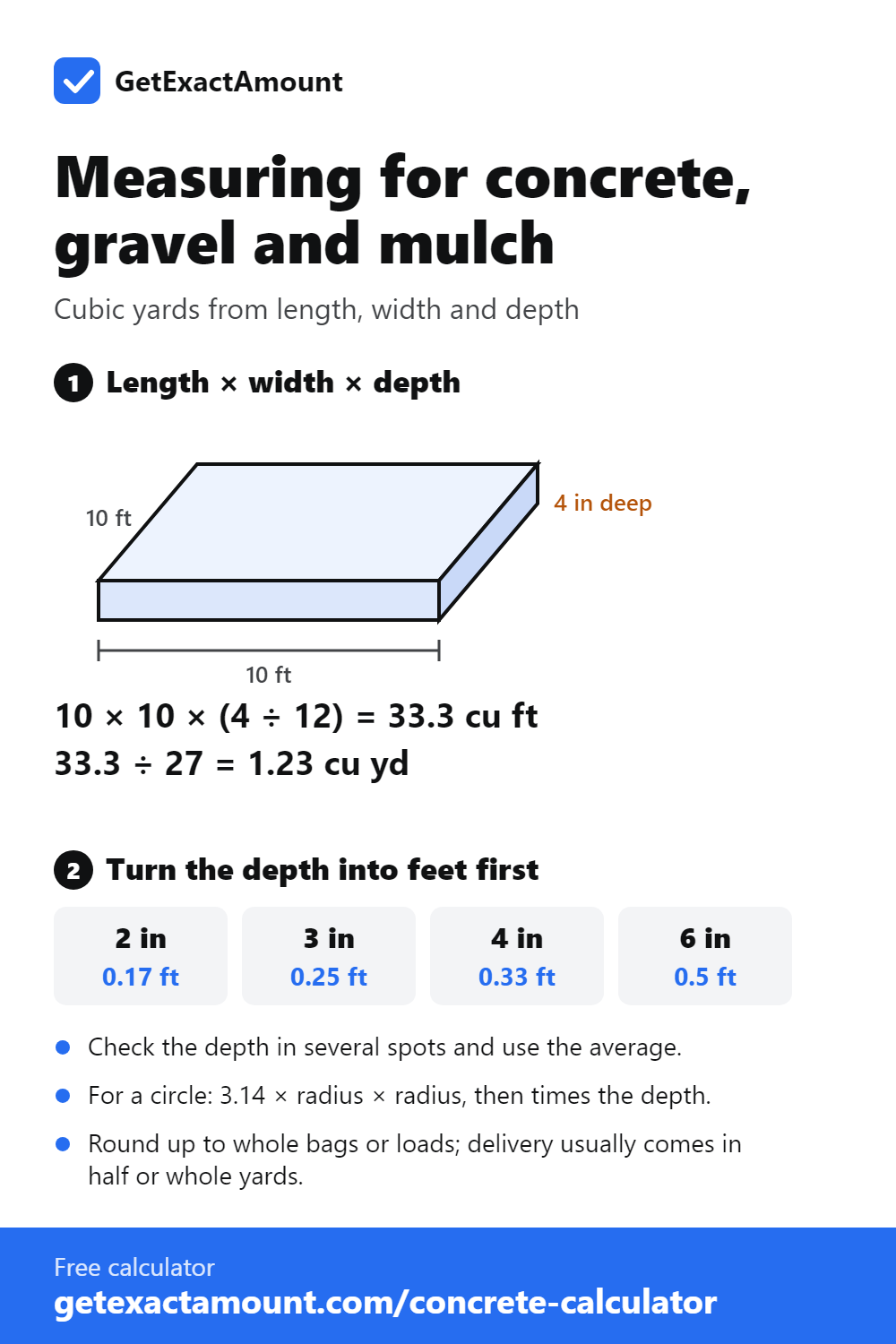
Chart as a table: How much gravel do I need?
| Area | 2 in | 3 in | 4 in |
|---|---|---|---|
| 3 × 20 ft (path) | 0.5 cu yd (≈ 0.67 tons) | 0.75 cu yd (≈ 1.01 tons) | 1 cu yd (≈ 1.35 tons) |
| 10 × 10 ft (patio) | 0.75 cu yd (≈ 1.01 tons) | 1 cu yd (≈ 1.35 tons) | 1.5 cu yd (≈ 2.02 tons) |
| 10 × 20 ft (parking pad) | 1.5 cu yd (≈ 2.02 tons) | 2 cu yd (≈ 2.7 tons) | 2.75 cu yd (≈ 3.71 tons) |
| 12 × 40 ft (driveway) | 3.25 cu yd (≈ 4.38 tons) | 4.75 cu yd (≈ 6.41 tons) | 6.25 cu yd (≈ 8.43 tons) |
| 20 × 50 ft (long driveway) | 6.5 cu yd (≈ 8.76 tons) | 9.75 cu yd (≈ 13.15 tons) | 13 cu yd (≈ 17.53 tons) |
How deep should gravel be?
| Use | Depth | Gravel |
|---|---|---|
| Decorative beds and borders | 2 in (50 mm) | Pea gravel, river rock |
| Garden paths | 2–3 in (50–75 mm) | Pea gravel or crushed stone, with edging |
| Driveways | 4–6 in (100–150 mm) over a base | Crushed stone, compacted |
| Base under pavers or a shed | 4–6 in (100–150 mm) | Crushed stone with fines, compacted |
Common mistakes
- Ordering loose volume for a compacted base. Crushed stone loses about a fifth of its volume when compacted.
- Using rounded pea gravel on a driveway. It rolls under tires; crushed stone locks together.
- Skipping landscape fabric. Weeds push through and the gravel sinks into the soil.
- Buying dozens of bags when a bulk delivery is cheaper and arrives on a pallet.
What else you'll need
- Landscape fabric (geotextile) under the gravel.
- Edging to keep gravel off lawns and beds.
- A plate compactor for bases (often rented) and a rake.
- Sand for paver bedding: Sand Calculator
Frequently asked questions
How much does a cubic yard of gravel weigh?
About 2,400–2,900 lb (1.1–1.3 short tons), depending on the stone and how wet it is. We use 2,700 lb for crushed stone.
How many bags of gravel are in a cubic yard?
About 54 bags of 0.5 cu ft. For more than half a yard, bulk delivery is usually cheaper.
How much gravel do I need for a driveway?
Plan 4–6 in of crushed stone over a compacted base. A 12 × 40 ft driveway at 4 in is about 6 cu yd before compaction.
Pea gravel or crushed stone?
Pea gravel is smooth and comfortable underfoot for paths and play areas. Crushed stone has sharp edges that lock together, so it is better for driveways and bases.
Related calculators
This is an estimate. Actual use depends on the material, the surface, the installation method, waste and site conditions. Check quantities with your supplier before you buy.