Self-Leveling Compound Calculator
Enter the floor size and the average depth you need to fill. We work out the weight of floor leveler and the bags to buy.
Your estimate
Buy 9 bags
9 bags (50 lb) of self-leveling compound
- Floor area
- 180 sq ft
- Average depth
- 1/4 in
- Compound
- 411 lb10% waste
Add a price per bag to see the cost.
How we got this: 180 sq ft × 1/4 in × 8.3 lb/sq ft per in × 1.10 = 411 lb, rounded up to whole bags.
Prime the floor with the maker's primer first: it stops the subfloor sucking water out of the compound and causing pinholes.
How the calculation works
- Average depth. Self-leveler fills the low spots, so the average depth across the floor matters more than the deepest dip.
- Weight. Area × depth × about 1.6 kg of powder per m² for every mm of depth (roughly 8.3 lb per sq ft per inch).
- Bags. Plus 10% for what stays in the bucket and flows into gaps, rounded up to whole bags.
Imperial example: a 12 × 15 ft floor at an average of 1/4 in takes about 187 kg (412 lb) with waste: 9 bags of 50 lb.
Metric example: a 4 × 5 m floor at an average of 5 mm takes 176 kg with waste: 8 bags of 25 kg.
Guides to save and share
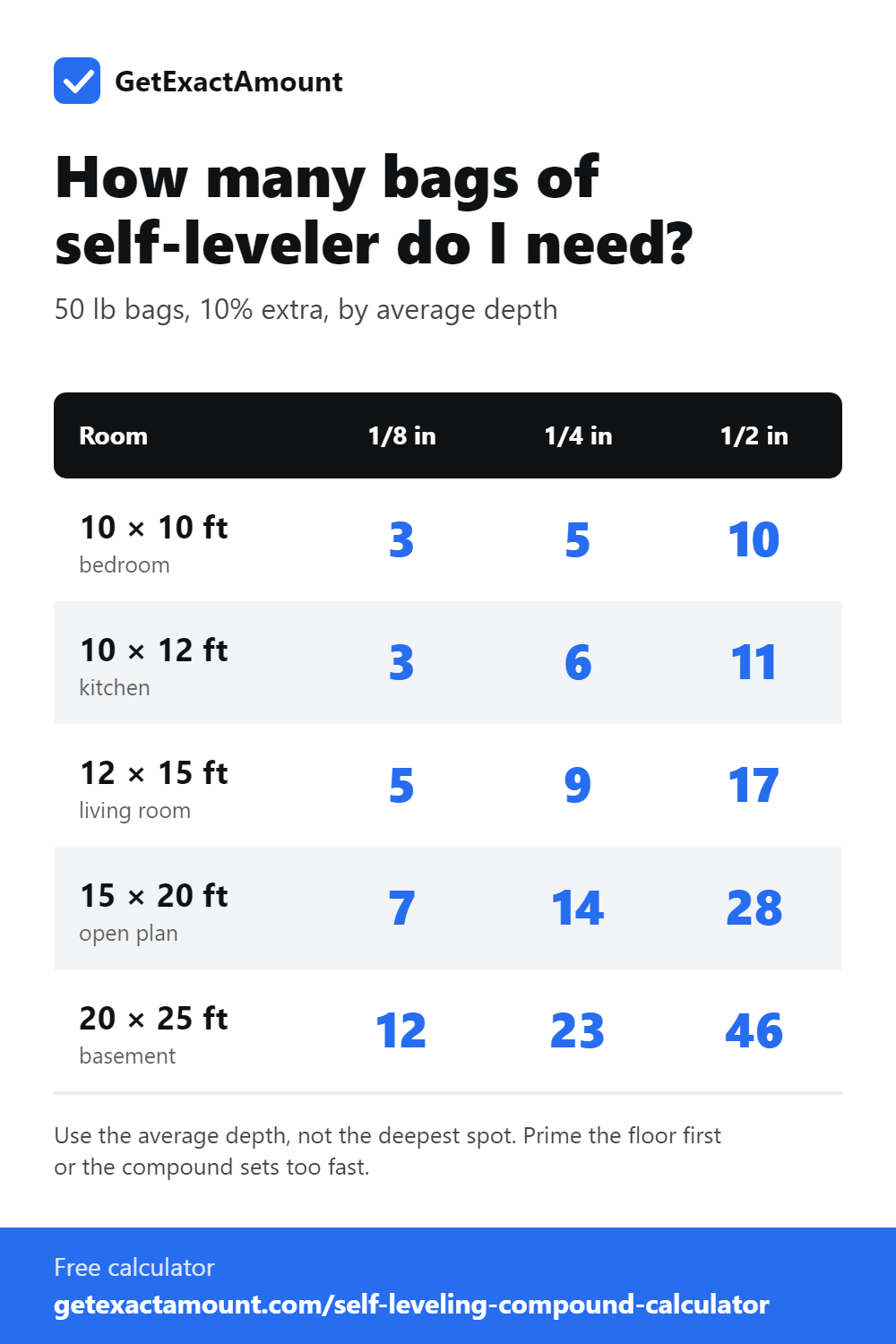
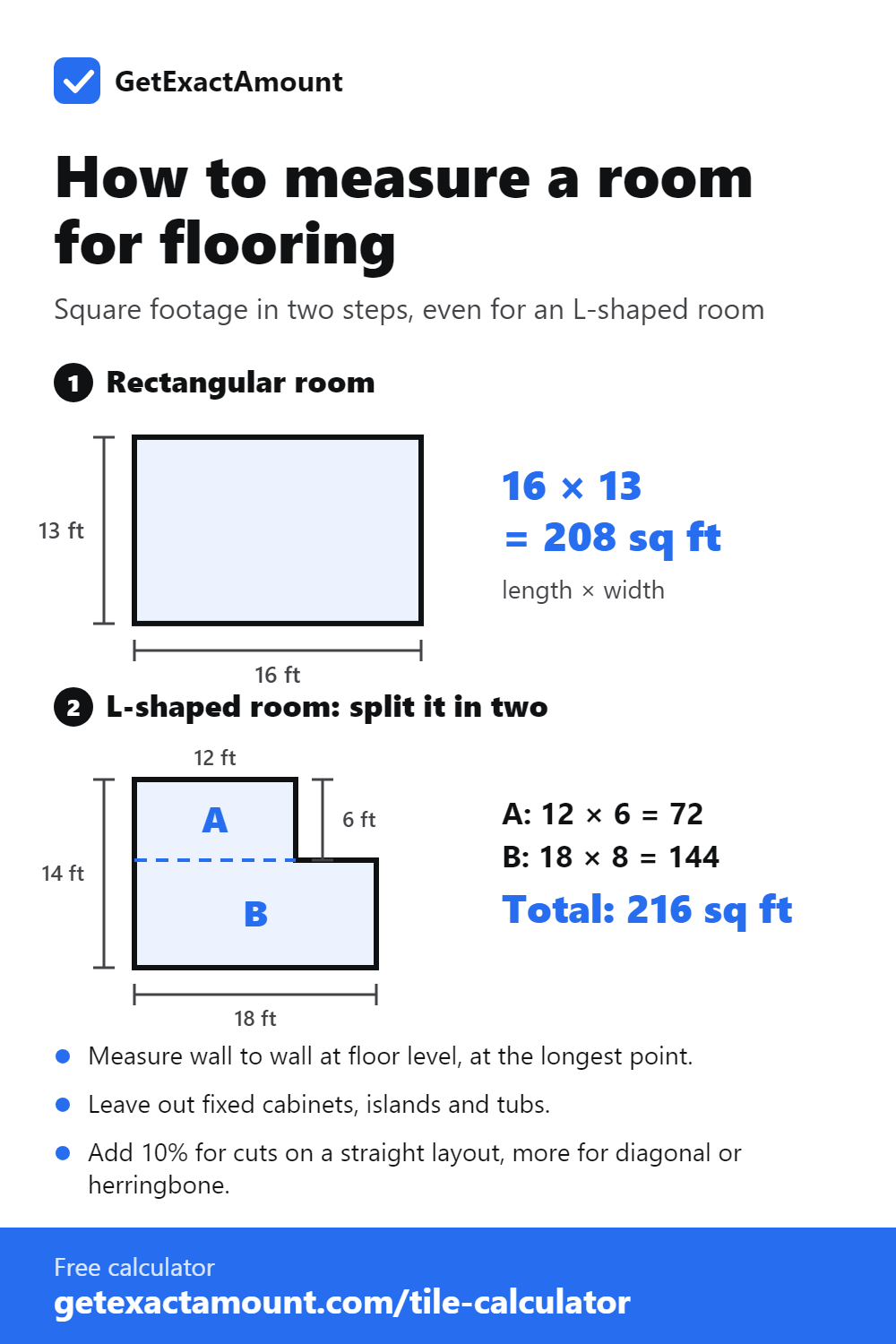
Chart as a table: How many bags of self-leveler do I need?
| Room | 1/8 in | 1/4 in | 1/2 in |
|---|---|---|---|
| 10 × 10 ft (bedroom) | 3 | 5 | 10 |
| 10 × 12 ft (kitchen) | 3 | 6 | 11 |
| 12 × 15 ft (living room) | 5 | 9 | 17 |
| 15 × 20 ft (open plan) | 7 | 14 | 28 |
| 20 × 25 ft (basement) | 12 | 23 | 46 |
Self-leveler or screed?
| Depth to fill | Product | Why |
|---|---|---|
| Under 1/8 in (3 mm) | Feather-finish or patching compound | Too thin for most self-levelers to flow and cure. |
| 1/8–1 1/2 in (3–40 mm) | Self-leveling compound | Flows flat on its own; walk-on in a few hours. |
| Over 1 1/2 in (40 mm) | Deep-pour leveler or screed | Thick layers of standard leveler can crack and cost far more. |
Common mistakes
- Skipping the primer. An unprimed slab sucks water out of the compound, leaving pinholes and a weak surface.
- Mixing by eye. Use the exact water on the bag: extra water makes it flow nicely and then crack or dust.
- Pouring in small batches with gaps between them. Each batch must flow into the last while it is still wet.
- Forgetting to seal holes and edges. Leveler finds every gap and runs under walls or into the room below.
What else you'll need
- The maker's primer and a roller or brush.
- A mixing paddle, a drill and two large buckets (one to mix, one for water).
- A gauge rake or smoother, and spiked shoes for walking on the wet pour.
- Foam edge strip or tape, and filler for cracks and holes.
- For deeper fills: Screed Calculator
Frequently asked questions
How much self-leveling compound do I need?
About 1.6 kg per m² for every mm of depth, or roughly 8 lb per sq ft per inch. A 12 × 15 ft floor at 1/4 in needs about 9 bags of 50 lb.
How many square feet does a bag of self-leveler cover?
A 50 lb bag covers about 50 sq ft at 1/8 in, or 25 sq ft at 1/4 in. The bag gives coverage at several depths for that product.
How thin can self-leveling compound go?
Most products need at least 1/8 in (3 mm). For thinner skims, use a feather-finish compound.
Do I need to prime before self-leveler?
Yes. Primer seals the subfloor, helps the compound bond and stops pinholes. Use the primer made for that leveler.
How long before I can lay flooring on it?
Many levelers take foot traffic in 2–4 hours and tile the next day, but vinyl and wood often need longer. Check the bag and test moisture for wood floors.
Related calculators
This is an estimate. Actual use depends on the material, the surface, the installation method, waste and site conditions. Check quantities with your supplier before you buy.