Ceiling Paint Calculator
Enter the size of each ceiling and whether it is smooth or textured. We work out the paint and the cans, and you can add every room in one go.
Your estimate
Buy 1.25 gallons
1 × 1 gal + 1 × quart of ceiling paint
- Ceiling area
- 168 sq ft
- Paint needed
- 1.06 gal
- Coats
- 2
- Extra paint
- 10%
Add a price per gallon to see the cost.
How we got this: 168 sq ft × 2 coats ÷ 350 sq ft/gal × 1.10 = 1.06 gal, rounded up to 1 × 1 gal + 1 × quart.
Flat ceiling paint hides roller marks and small flaws best. Paint the ceiling before the walls, so drips land where you will paint next.
How the calculation works
- Ceiling area. Length × width of each room, added together. On a flat ceiling, that is the floor area.
- Texture. Popcorn and knockdown ceilings have far more surface than they look. We add 30%.
- Paint and cans. Area × coats ÷ coverage, plus 10%, rounded up to the cans sold where you shop.
Imperial example: a 12 × 14 ft ceiling is 168 sq ft. Two coats at 350 sq ft per gallon plus 10% is 1.06 gallons: a gallon and a quart. Textured, it is 1.37 gallons: a gallon and two quarts.
Metric example: a 4 × 5 m ceiling is 20 m². Two coats at 8.6 m² per liter plus 10% is 5.1 L: a 5 L tin and a 1 L tin.
Guides to save and share
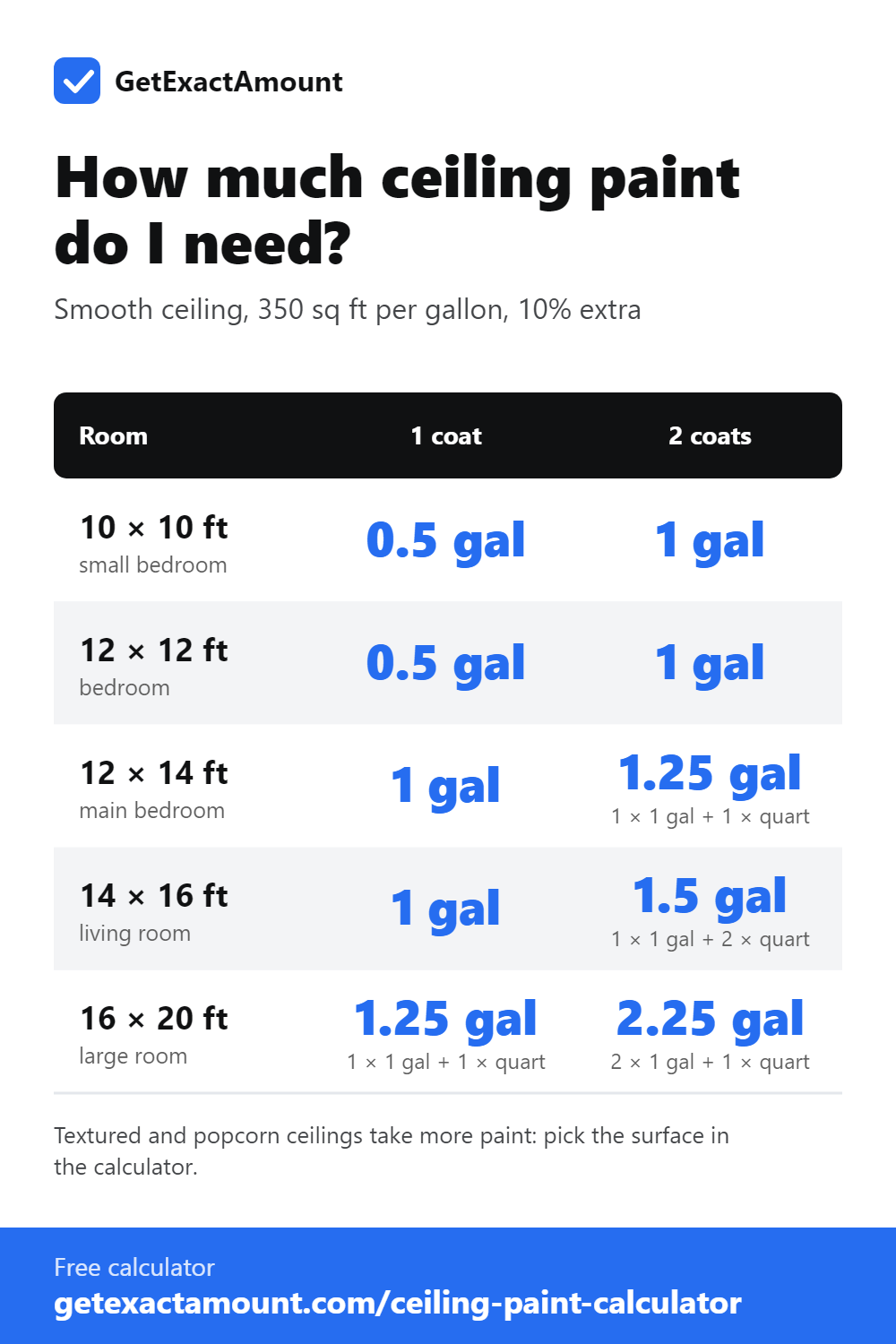
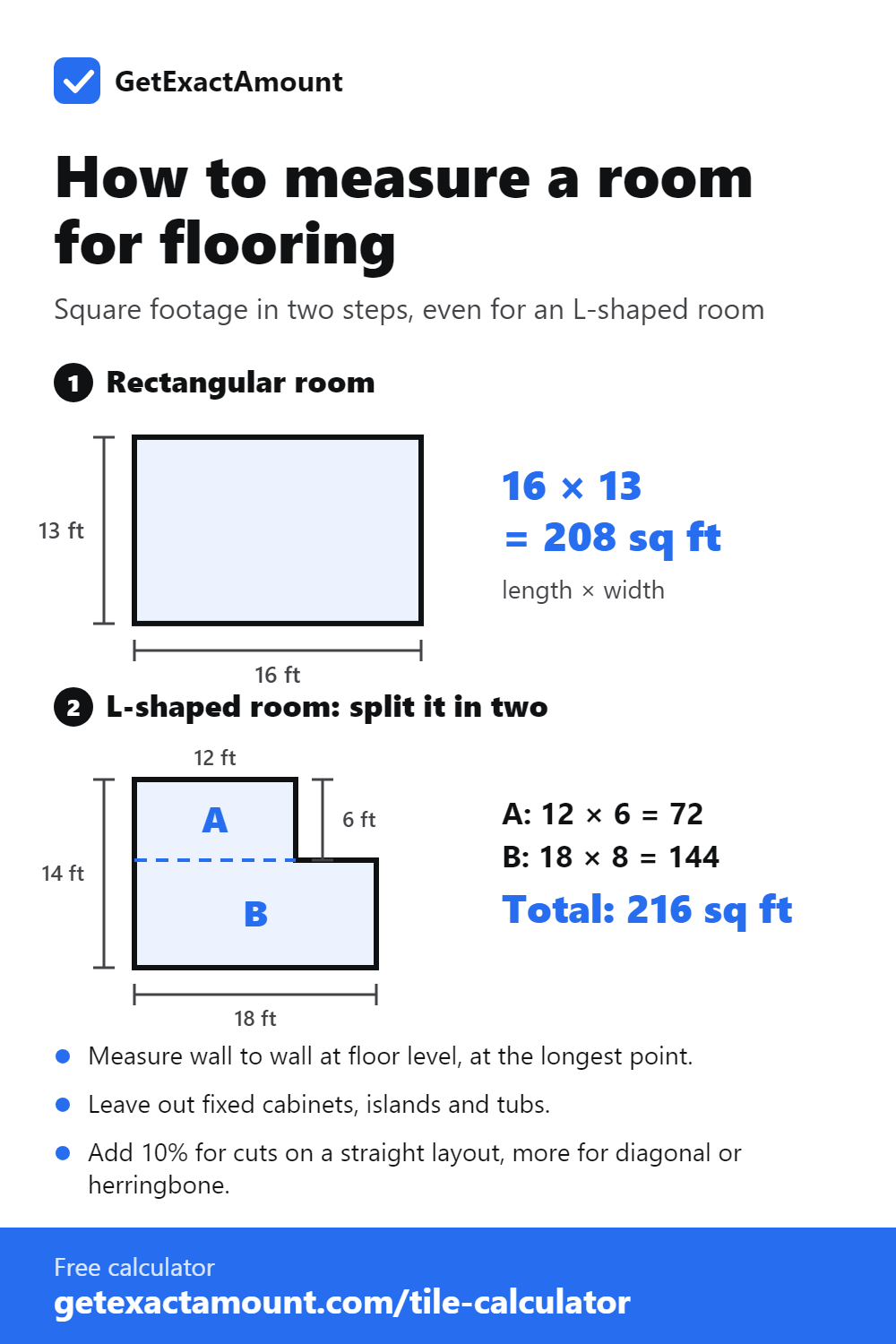
Chart as a table: How much ceiling paint do I need?
| Room | 1 coat | 2 coats |
|---|---|---|
| 10 × 10 ft (small bedroom) | 0.5 gal | 1 gal |
| 12 × 12 ft (bedroom) | 0.5 gal | 1 gal |
| 12 × 14 ft (main bedroom) | 1 gal | 1.25 gal (1 × 1 gal + 1 × quart) |
| 14 × 16 ft (living room) | 1 gal | 1.5 gal (1 × 1 gal + 2 × quart) |
| 16 × 20 ft (large room) | 1.25 gal (1 × 1 gal + 1 × quart) | 2.25 gal (2 × 1 gal + 1 × quart) |
How much waste should I add?
| Ceiling | Extra paint | Why |
|---|---|---|
| Smooth, repainting white | 5–10% | Cutting in along the walls and around light fittings. |
| New drywall or stains | 10–15% | Patchy absorption; prime stains first. |
| Popcorn or knockdown texture | 30% more area, plus 10% | The texture soaks up paint and holds it in every hollow. |
Common mistakes
- Using wall paint on the ceiling. Flat ceiling paint is thicker, spatters less and hides roller lines.
- Painting stains without a stain-blocking primer. Water marks bleed through two coats of latex.
- Rolling a textured ceiling with a short nap. The roller skips the hollows and pulls texture off.
- Working in small patches. Keep a wet edge and finish the ceiling in one go to avoid lap marks.
What else you'll need
- A stain-blocking primer for water marks or smoke stains.
- An extension pole, a roller with a 3/8 in nap (smooth) or 3/4–1 in nap (textured), and a tray.
- An angled brush for cutting in along the walls.
- Drop cloths and painter's tape; take down or cover light fittings.
- Safety glasses: paint drips from overhead.
Frequently asked questions
How much paint do I need for a ceiling?
Divide the ceiling area by the coverage on the can (about 350 sq ft per gallon) for each coat, then add 10%. A 12 × 14 ft ceiling with two coats needs a gallon and a quart.
Does a textured ceiling need more paint?
Yes, often 25–50% more. We add 30%. Use a thick-nap roller so paint reaches the hollows.
Can I use wall paint on a ceiling?
You can, but flat ceiling paint is made for the job: it is thicker, drips and spatters less, and hides imperfections under side light.
Should I paint the ceiling or the walls first?
Ceiling first. Drips and roller spatter then land on walls you have not painted yet.
Is it safe to paint a popcorn ceiling?
In a home built before the 1990s, have the texture tested for asbestos before you disturb it. Painting over a sound, tested ceiling is usually fine; scraping it is not.
Related calculators
This is an estimate. Actual use depends on the material, the surface, the installation method, waste and site conditions. Check quantities with your supplier before you buy.