Drywall (Plasterboard) Calculator: Sheets, Screws & Compound
Enter your room size to see how many sheets of drywall to buy for the walls and ceiling, with the screws, joint compound and tape to finish them.
Your estimate
Buy 19 sheets
4 × 8 ft drywall · plus screws, compound and tape
- Area to cover
- 533 sq ft (ceiling 168 sq ft)
- Openings subtracted
- − 51 sq ft1 door, 2 windows
- Waste
- 10%
- Screws
- about 530 · 2 × 1 lb box
- Joint compound
- 5.33 gal · 1 × 4.5 gal box + 1 × 1 gal
- Joint tape
- 197 ft · 1 roll (250 ft roll)
Add a price per sheet to see the cost.
How we got this: 533 sq ft × 1.10 ÷ 32 sq ft per sheet = 18.32, rounded up to 19 sheets.
Hang the ceiling first, with 5/8 in (15 mm) sag-resistant board, then the walls.
How the calculation works
- Area. Wall perimeter × height, minus doors and windows by their size, plus the ceiling if you include it.
- Sheets. Area plus 10% waste, divided by the area of one sheet, rounded up.
- Screws. About 1 per sq ft (roughly 32 per 4 × 8 sheet).
- Joint compound and tape. About 1 gallon of compound per 100 sq ft for three coats, and 370 ft of tape per 1,000 sq ft.
Imperial example: a 12 × 14 ft room with 8 ft walls, one door, two windows and the ceiling is 533 sq ft. With 10% waste that is 19 sheets of 4 × 8 ft, about 530 screws, 5.3 gallons of compound and 197 ft of tape.
Metric example: a 4 × 5 m room with 2.5 m walls, one door, one window and the ceiling is 61.7 m². With 10% waste that is 24 sheets of 1200 × 2400 mm plasterboard and a 90 m roll of tape.
Guides to save and share
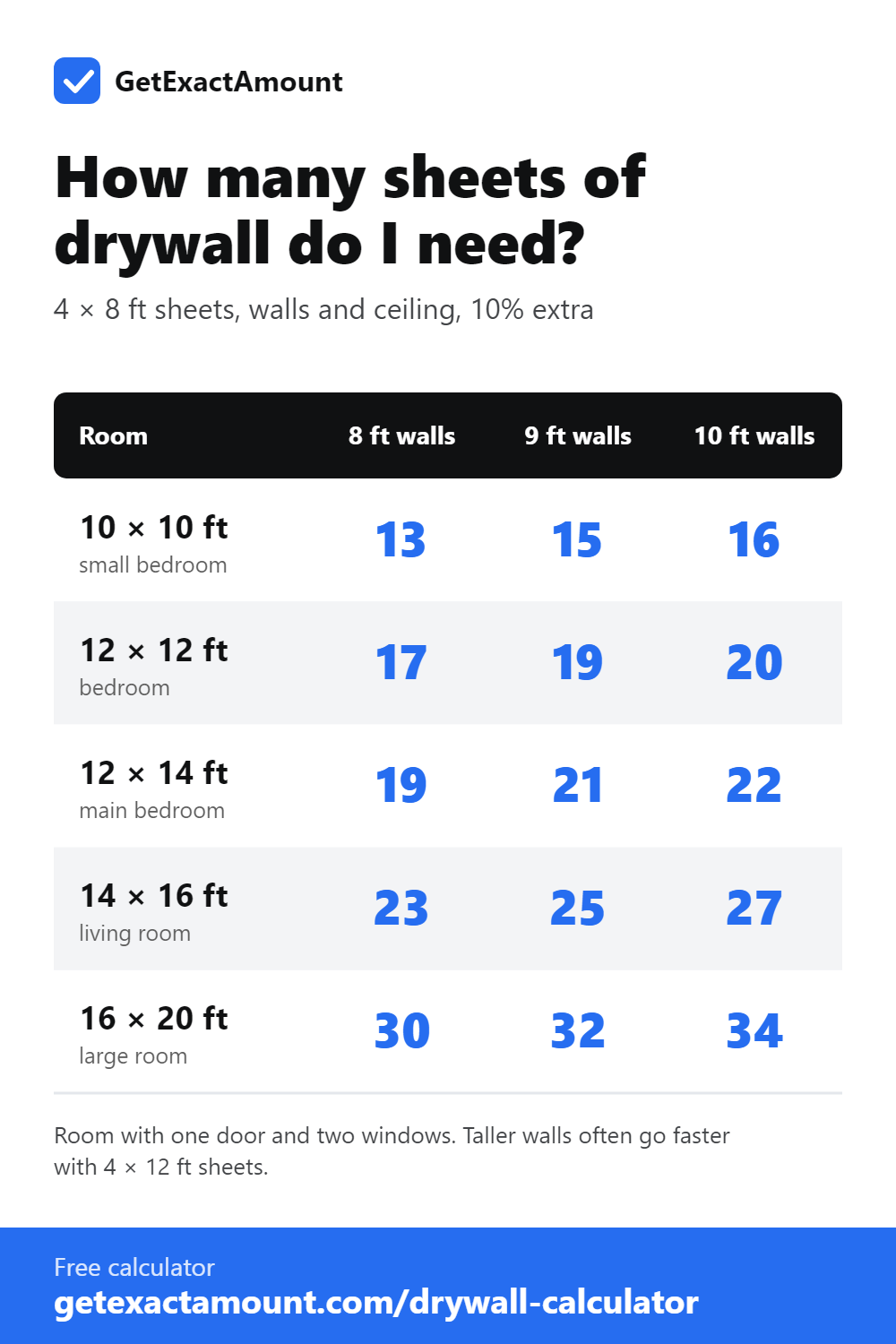
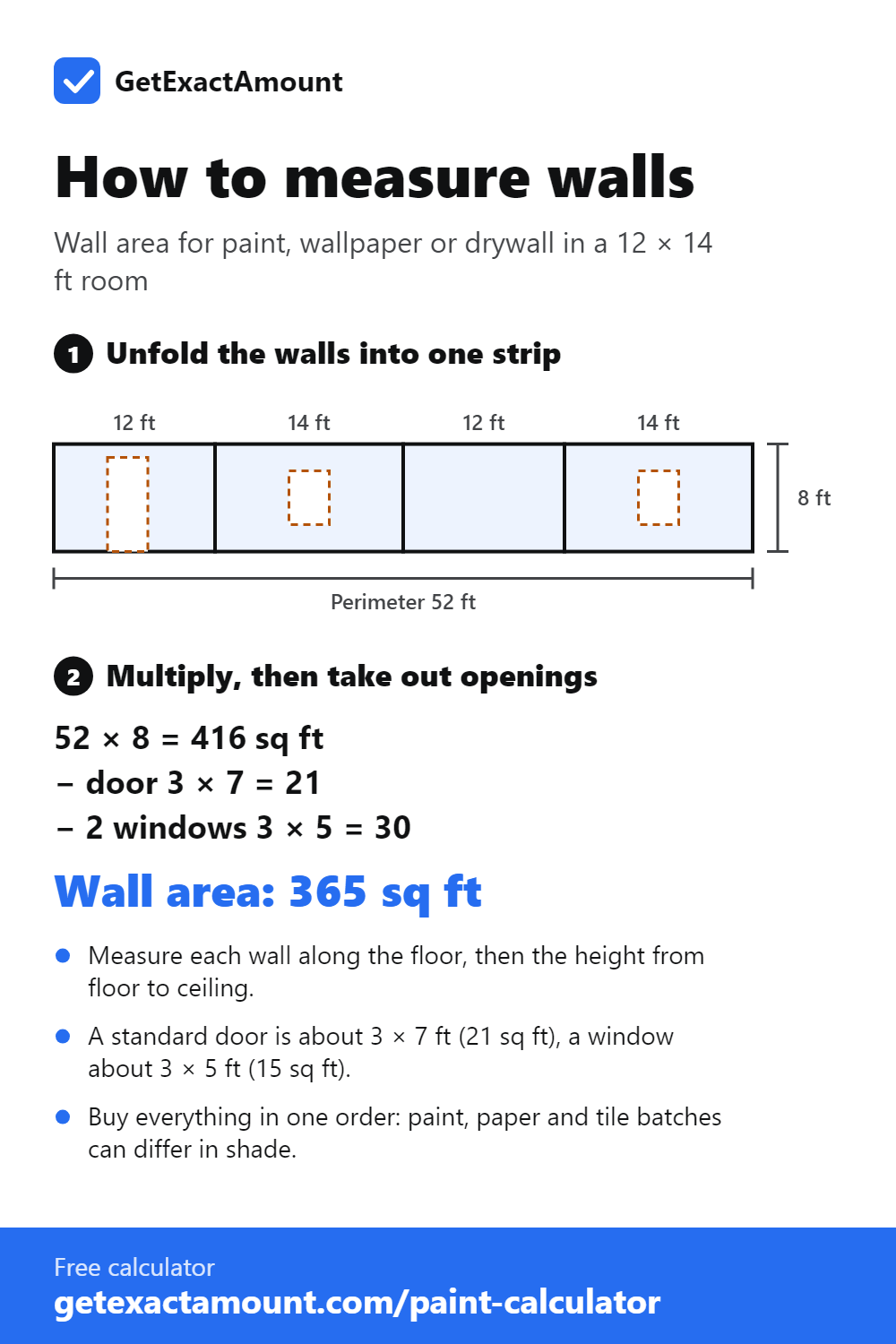
Chart as a table: How many sheets of drywall do I need?
| Room | 8 ft walls | 9 ft walls | 10 ft walls |
|---|---|---|---|
| 10 × 10 ft (small bedroom) | 13 | 15 | 16 |
| 12 × 12 ft (bedroom) | 17 | 19 | 20 |
| 12 × 14 ft (main bedroom) | 19 | 21 | 22 |
| 14 × 16 ft (living room) | 23 | 25 | 27 |
| 16 × 20 ft (large room) | 30 | 32 | 34 |
How much waste should I add?
| Room | Extra sheets | Why |
|---|---|---|
| Plain walls, few openings | 10% | Offcuts at the ends of walls. |
| Many openings, angles or stairs | 15% | Cutouts leave pieces too small to reuse. |
| Ceilings with lights and vents | 15% | Every fixture needs a cutout. |
Common mistakes
- Using 4 × 8 sheets on tall walls. Longer sheets mean fewer joints to tape and sand.
- Using regular board in a bathroom. Use moisture-resistant board, and cement board behind tile in showers.
- Lining up end joints. Stagger them between rows so cracks do not run in a line.
- Forgetting corner bead for every outside corner.
What else you'll need
- Drywall screws and a screw gun with a dimpler bit.
- Joint compound and paper or mesh tape.
- Corner bead for outside corners.
- A T-square, utility knife and drywall saw.
- Taping knives (6, 10 and 12 in), a sanding sponge and primer.
Frequently asked questions
How many sheets of drywall do I need for a 12×12 room?
With 8 ft walls, one door, one window and the ceiling, a 12 × 12 ft room is about 492 sq ft. With 10% waste that is 17 sheets of 4 × 8 ft.
What size drywall sheet should I use?
Use the longest sheet you can carry and fit through the door. 4 × 8 ft (1200 × 2400 mm) is standard; 4 × 12 ft sheets cut down on joints on long walls and ceilings.
How many screws per sheet of drywall?
About 32 screws per 4 × 8 sheet on walls with studs at 16 in, roughly one per square foot. Ceilings use a few more because of closer spacing.
How much joint compound do I need?
About 1 gallon of ready-mixed compound per 100 sq ft of drywall for three coats (tape, fill and finish), or roughly 0.4 L per m².
What thickness of drywall should I use?
In the US, 1/2 in for walls and 5/8 in for ceilings and fire-rated walls. In the UK and Australia, 12.5 mm (13 mm) is standard and 15 mm is used for ceilings and sound or fire ratings.
Related calculators
This is an estimate. Actual use depends on the material, the surface, the installation method, waste and site conditions. Check quantities with your supplier before you buy.