Cement Calculator: Bags, Sand and Gravel by Mix Ratio
Mixing concrete or mortar yourself? Enter the size and pick the mix. We split the dry materials by ratio and round the cement up to whole bags.
Your estimate
Buy 11 bags of cement
Concrete 1:2:3 · plus 1.13 tons of sand and 1.69 tons of gravel
- Volume
- 1.63 cu yd10% waste
- Cement
- 1,015 lb · 11 bags (94 lb)
- Sand
- 1.13 tons
- Gravel (coarse aggregate)
- 1.69 tons
Add a price per bag of cement to see its cost.
How we got this: 1.63 cu yd × 1.54 for dry materials = 2.51 cu yd, split 1:2:3. Cement at 1,440 kg/m³, sand and gravel at 1,600 kg/m³.
For more than about 1 cu yd (0.75 m³), ready-mix concrete is usually cheaper and more consistent than mixing by hand.
Strength comes from the water–cement ratio: add only enough water to make the mix workable. A sloppy mix is weaker.
How the calculation works
- Wet volume. Length × width × depth, plus 10% for spills and uneven ground.
- Dry volume. Sand and gravel fill each other's gaps, so you need more dry material than the finished volume: about 1.54 times for concrete and 1.27 times for mortar.
- Split by ratio. The dry volume is divided by the parts in the mix. Cement weighs about 1,440 kg/m³ and sand and gravel about 1,600 kg/m³.
Imperial example: a 10 × 12 ft slab, 4 in thick, at 1:2:3 needs 11 bags of 94 lb cement, 1.1 tons of sand and 1.7 tons of gravel.
Metric example: a 3 × 3 m slab, 100 mm thick, at 1:2:3 needs 15 bags of 25 kg cement, 813 kg of sand and 1,220 kg of gravel.
Guides to save and share
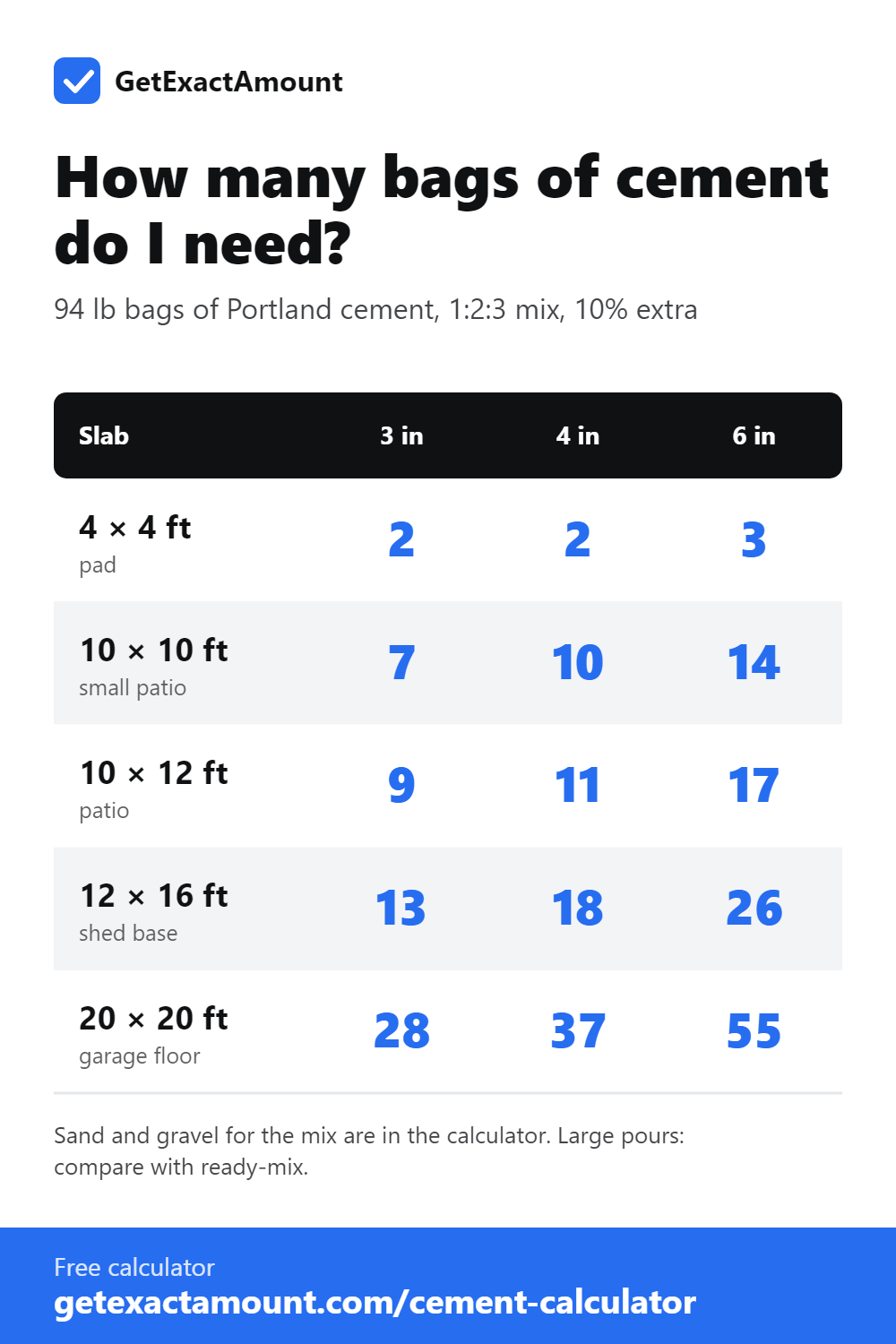
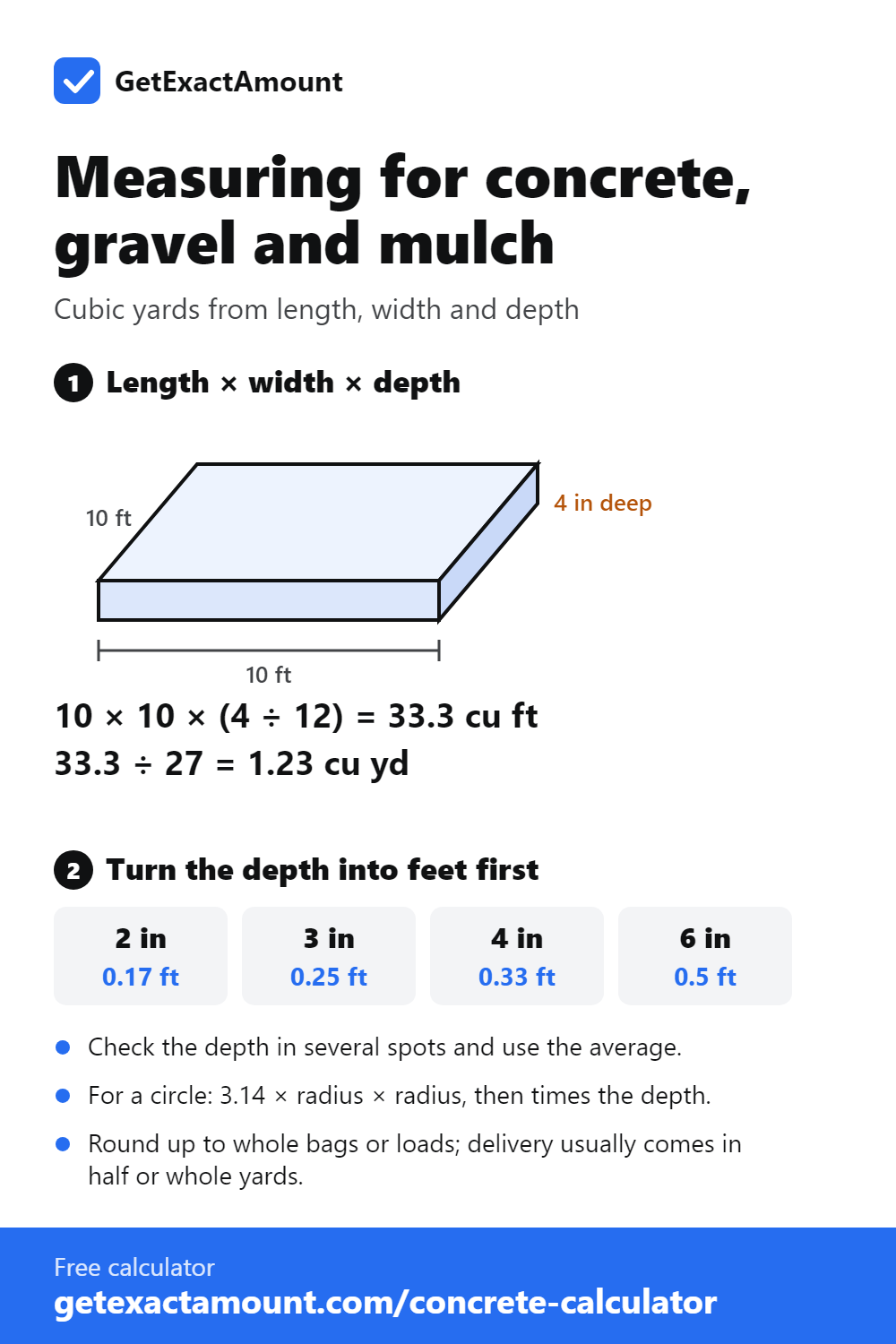
Chart as a table: How many bags of cement do I need?
| Slab | 3 in | 4 in | 6 in |
|---|---|---|---|
| 4 × 4 ft (pad) | 2 | 2 | 3 |
| 10 × 10 ft (small patio) | 7 | 10 | 14 |
| 10 × 12 ft (patio) | 9 | 11 | 17 |
| 12 × 16 ft (shed base) | 13 | 18 | 26 |
| 20 × 20 ft (garage floor) | 28 | 37 | 55 |
Which mix ratio should I use?
| Mix | Use | Notes |
|---|---|---|
| 1:2:3 concrete | Slabs, footings, post holes | A strong general-purpose mix. |
| 1:2:4 concrete | Paths, bases, mass fill | Slightly leaner and cheaper. |
| 1:4 mortar | Bricklaying, rendering | Add lime or plasticizer for workability if the maker allows. |
| 1:5 mortar | General bricklaying, soft bricks | Weaker and more flexible than 1:4. |
Common mistakes
- Measuring by shovel. Use the same bucket for every part so the ratio stays true.
- Adding water until it pours. Every extra drop of water weakens the concrete.
- Forgetting the dry-volume factor. Ordering sand and gravel for the wet volume leaves you a third short.
- Mixing more than you can place in about an hour.
What else you'll need
- A cement mixer (rented) or a wheelbarrow and hoe for small batches.
- Buckets for measuring parts, and a hose.
- Formwork boards, stakes and a level for slabs.
- Reinforcing mesh or rebar if the job needs it.
- Sharp (concrete) sand and gravel, or all-in ballast. Sand Calculator
Frequently asked questions
How many bags of cement do I need for 1 cubic yard of concrete?
At 1:2:3, about 7 bags of 94 lb per cubic yard (or 15 bags of 25 kg per m³), before waste. Leaner mixes such as 1:2:4 need less.
What does 1:2:3 mean?
One part cement, two parts sand and three parts gravel, measured by volume with the same bucket.
Why do I need more dry material than the finished volume?
Sand fills the gaps between stones and cement fills the gaps in the sand, so the mix shrinks when combined. Allow about 1.54 times the wet volume for concrete.
Should I mix my own concrete or buy premix bags?
Mixing your own is cheaper for medium jobs; premix bags are easiest for small ones. Above about 1 cu yd (0.75 m³), ready-mix is usually best.
Related calculators
This is an estimate. Actual use depends on the material, the surface, the installation method, waste and site conditions. Check quantities with your supplier before you buy.